Showing posts with label history. Show all posts

Tuesday, 4 December 2012

Out and About in Oxford-Town: Part I

This weekend Amy and Libby ventured to Paris via a nine hour, overnight coach ride to, as we say jokingly, "repair their friendship." As a result, Caitlin and I decided we had to do something fun while they were gone.

Sunday

We chose to visit the Pitt Rivers Museum for the second time. The first time we went (read more about it here) we only managed to see the ground floor because there were so many displays. Our goal this time was to finish the top two floors before trying to get some Christmas shopping done.

The sky was a soft blue with wispy clouds that were a welcome sight after so many days of clouds and rain. The temperature has finally dipped low enough (under 40 degrees Fahrenheit) for me to really feel the cold when outside. The frosty air numbs the fingers and ears if they are not covered properly.

Beyop
The first floor (second floor in America) of the museum was dedicated to more daily-life type artifacts like bags, body ornaments, baby carriers, games, and art. I never realized just how many ways human beings adorn their bodies. Necklaces, bracelets, finger rings, toe rings, headdresses, anklets, and waist adornments were all there.

The female members of the Adi of northeast India wore metal disks attached to a string around their waists. This ornamentation, called a beyop, was worn daily from the time the girl could walk until the birth of her first child.

Bags from around the world
The most interesting exhibits were about important stages in a person's life: childhood, puberty, and marriage.

The display on body modification was also very informative, though I already knew most of the basics about scarification and tattooing. One body modification I had not heard of before was head shaping, a practice normally found in African cultures. Mothers would use cloth or a specially made apparatus to gradually make their newborn baby's head more elongated. The reshaping process took several weeks of application for about fifteen minutes a day during the child's nap. Surprisingly, the information plaque said that the process is not harmful.

There were also several brightly colored silk shoes worn by Chinese women who had their feet bound on display in this section. I knew that their feet were small, but not that they were that small. The shoes looked like they would only fit the feet of little babies. I cannot imagine how painful it must have been for the women.

Further along the room were decorated eggs, and not just chicken eggs. There was a painted ostrich egg and some were very small and probably came from some kind of songbird. Each one was hand painted with incredible detail.


In this same section were paintings from different cultures. My eye was drawn to two African paintings done in purples, greens, and browns on a background of black paper. They depicted antelopes, warriors, and birds in a slightly abstract tribal style. I really like the thin, angular quality of the images where you can tell what they are without it being strictly accurate to porportions. The bright colors and spindly trees with poofs of leaves remind me of the book The Lorax by Dr. Seuss.
   

The top floor did not have nearly as many artifacts as the two floors below. Its displays focused mainly on weaponry, armor, and fishing. There were bunches of guns, but I did not spend very long looking at them. All of the swords and daggers were much prettier and interesting, though I did make myself a little queasy imagining what being stabbed by one would feel like. I had two favorites among the swords and daggers. The first was a plain sword from Asia with a slightly curved blade, about three feet long, with a hilt made of beige twine. It's simplicity was very appealing to the eye. My other favorite was a dagger with a hilt made of a pale, milky blue stone.

As we were heading out of the museum past the national history section, I saw this guy gazing out of a glass display case.


Yeah, I know, super creepy, right? He looks like he should be the mischievous minion of some evil villain...or he could be just contemplating when to lunge forward and bite you on the nose.

-------- 0 --------

We (meaning mostly me) tried to do some Christmas shopping after the museum, but I just wasn't feeling it. There were just too many people everywhere and I did not know exactly what I was looking for. We mostly just ended up wandering around Primark, Apricot, and Miss Selfridge (all clothing stores) without buying anything.

When we got hungry, it was off to the Covered Market for sandwiches at a French deli. We ate there our first week in Oxford and thought it was good then. I had a panini with sundried tomato chicken, mozzarella and basil. It was a very good combination of flavors, filling but inexpensive.  

All of this was accomplished before 4pm. We spent the rest of the day sitting at our kitchen table writing blog posts and doing homework while having tea and cookies.   

Monday, 19 November 2012

Cultural History and Scones

On Friday the 9th, we decided to explore more of the attractions Oxford has to offer. The four of us met Beth and rode into downtown Oxford, walking down Cornmarket Street to the Ashmolean. The Ashmolean is a museum filled with ancient artifacts like pottery, weaponry, and coinage, as well as several art and sculpture galleries.

Most of the rooms focused on either British, Roman or Chinese history. I most enjoyed looking at the currency exhibition and the pieces of jewelry scattered throughout the various rooms. They had bills displayed from all over the world, including money printed by the Confederacy during the American Civil War. There were thousands of coins in a range of sizes marked with the ruler of the time. The biggest ones were about 1 1/2 inches in diameter with the smallest about 1/4 inches in diameter. If coins today were that small I think I would be loosing them all of the time. Historians use coins to determine who were the rulers of Ancient Rome as each emperor had their likeness stamped on coins during their reign.

We moved on to the art galleries which were decorated with jewel toned wallpaper to fit the time periods of the paintings in their gilt frames. I perused most of the paintings quickly, pausing to read the plaques describing the artist and painting when one caught my interest. I can appreciate art and fairly intelligently discuss the symbolism and possible meaning the artist was trying to convey, as well as art techniques used, but I am very picky about what art I really enjoy.

At one point we all got a little separated as the rooms all seem interconnected, creating the feeling of a maze where you don't know where each turn and new doorway will take you. I managed to find Caitlin and we sat on a bench waiting for the others. To pass the time we discussed the painting directly in front of the bench. The focus of the painting was a sitting figure with shoulder-length blond hair, robes of pale pink and cobalt, and a light shining around the head. My guess was that the person might be the Virgin Mary since I believe she is often pictured in pink and blue robes with a halo. Seated around the figure were older men with greying hair and thick beards. To the far right were two more people, a man and a woman, with golden halo hovering over their heads.

The halos suggested a biblical scene but I did not know which one. Caitlin and I tried to make up stories about what was going on, and why all of these men were surrounding this feminine figure. Giving up the guessing, I rose from the comfortably padded bench and read the information plaque. We were pretty far off the mark. The central figure, which we thought was a woman due to the longer hair, fair face, and pink robes, was actually Jesus as a child when he first preached to the learned men of his village.

By this time we had managed to find each other. Only one floor was left for us to see and we moved through even more art galleries fairly quickly. The final room was smaller than the previous ones and decorated with emerald green wallpaper. Looking in the first alcove, I found that all of the paintings were appealing to me, and I spent several minutes reading their information cards. It was only when I was moving to another section to the room that I saw it was dedicated to artists of the Pre-Raphaelite art form which happens to be by favorite style.

The Pre-Raphaelite style is highly detailed with an emphasis on Nature. The paintings often depict characters from literature and myth. Scenes deriving from the Arthurian legends, Greek mythology, and the Shakespearean plays were all popular with the artists of the style.

William Holman Hunt, John Everett Millais and Dante Rossetti are often considered the founders of the art movement, though I am most familiar with the works of John William Waterhouse.

The gallery featured several paintings by William Holman Hunt which I found breathtaking with their emphasis on detail and the use of vibrant colors. I particularly liked The Afterglow in Egypt. According to the information plaque, Hunt had a very hard time getting the Egyptian girl in the painting to stand still long enough to sketch her properly.

Afterglow in Egypt
by William Holman Hunt
In the opposite alcove, there was a Waterhouse painting, and I had a bit of an "Oh my goodness, this is an actual painting by John William Waterhouse" moment. The Internet is so useful to learn about art, but it can not compare to actually standing before a famous painting in real life.

Ariadne by John William Waterhouse
The Waterhouse painting in the Ashmolean was Ariadne. It depicts Ariadne, the princess who gave a ball of string to Theseus to guide hime in the Minator's labyrinth. The two fell in love and eloped together but the goddess Athena demanded that Theseus leave Ariadne on a beach. The painting depicts the young woman, two leopards at her feet, reclining as Theseus' ship sails away.

We left the museum after I finished looking at the Pre-Raphaelite room and made our way down High Street to the Vaults and Garden Cafe for afternoon tea. The Vaults and Garden is in a beautiful rectangular room with vaulted ceilings that is attached to the Church of St. Mary the Virgin. The rustic tables and chairs were made from dark wood, and the dim lighting gave the cafe a very cozy feel.

I ordered English Breakfast tea and a scone. The tea came in a small green teapot to keep it warm. There were steel creamers, only two inches high, for holding the milk and sugar cubes. The large, golden brown, freshly made scone was served with clotted cream and raspberry jam. The scone was crispy on the outside but soft on the inside. I cut small pieces from the bread, spreading it with clotted cream then jam. I ate very slowly to appreciate how delicious all of the food tasted. I absolutely love the idea of having tea and a small snack in the afternoon to hold you over until dinner.

Wednesday, 14 November 2012

Caves and Italian Food

This past weekend was full of activities with a trip to Cardiff on Friday, Bonfire Night on Saturday, and  then a trip to Chislehurst Caves and London on Sunday.

Amy, Caitlin and I have several days left on our BritRail pass so we looked for day trips that take less than two hours to get to by train. Caitlin suggested Chislehurst Caves, a place she had visited on a previous trip to England. Caves are cool, and a nice change from museums so we agreed. Libby was sick from Bonfire Night so she stayed at the flat to rest.

Chislehurst is a suburb south-east of London. The little bit of the town we saw on the walk to the caves seemed quite and traditional with its brick houses and corner pub. We worried that the caves would be difficult to fin but we had no problems at all. You just walk down the road from the train station, turn right past the pub and then there are giant brown signs pointing the way. It was probably only a seven minute walk from the rail station to the caves.

The tours started on the hour so we had about fifteen minutes to wait around in the lobby which was a combination of wooden pew-like benches and a separate room with a small cafe.

At noon, our tour group, made up of about six parents, six children, and us three, ventured down to the caves entrance which was under the building we were in. Old fashioned oil lanterns were distributed among the adults to light the way. Only a few parts of the caves were fitted with electricity and lights from flashlights, cameras, and other technology would not be good for our eyes inside the caves (therefore I have not photographs from inside the caverns).

The Chislehurst Caves were formed completely by hand as the Druids, Saxons, and Romans mined for chalk. The maze of caverns would measure 22 miles if it could be stretched into a straight line. Over the centuries it has played host to sacrificial ceremonies of the Druids, music concerts, and murders hiding bodies.

During WWII, when London was being bombed by the Germans, 15,000 people used the caves as a bomb shelter. Families would pay a weekly fee and be assigned an "address" which would be painted on the cave wall. There were showers, a hospital and a chapel. People slept on narrow bunk beds, at least three beds high. Every night at 10:30 pm, all lights had to be extinguished because they could be seen through cracks in the ground by the German planes flying above. This would leave thousands of people in absolute darkness until morning. I have no idea what you would do if you needed the toilet in the middle of the night, but the rules worked. Not a single person died from bombings while sheltered inside the caves.

One child was born in the caves in the hospital. The baby girl was christened in the cave's chapel and named Cavena, though she preferred to go by Rose.

In the mid-20th century, musicians discovered the pleasing affects of the cave's echoes and began to hold concerts down in the caverns. David Bowie, Pink Floyd, the Rolling Stones and Jimi Hendrix all played there at one time or another.

Our group looked at the chapel before moving farther into the dark reaches of the cave with only out lanterns as light. We stopped at the alter of the Druids where women and children were sacrificed to the gods. Our group was told by the tour guide to gather in an alcove next to the alter and he would leave us in the dark for several seconds to experience the all consuming blackness. Caitlin was kind enough to hold my hand for this part. I was not frightened, but it is nice to know that you are not alone when you can not see anything.

The guide walked some ways away and began to bang on a metal drummer to show us how well sounds travel in the confined space. The drumming stopped and we waited for him to come back when, "Bang!," he hit the drum one more time incredibly hard. We all startled and jerked then began some nervous chuckles to ease the tension. I was trying to listen for the tour guide's footsteps coming towards us. Everyone screamed as his flashlight came on right before us. I guess he had used the time we were recovering from the loud bang to make his way back to us unheard for the express purpose of scaring us.

Next we moved on to the area that was considered most haunted. Before walking down the narrow corridor to this area, the tour guide said, "Now, before people report seeing a white mist, they usually feel a chill and sometimes the echoes in the cave are dampened. It is impossible to feel a chill because the caves are always at a constant temperature of 50 degrees Fahrenheit not matter the weather outside."

Right when he said that I felt a chill move down the back of my body until a tingle set up residence in the backs of my calves. Then when we walked through the tunnel to the cavern beyond I thought that the echoes were less pronounced. The tour guide remarked on that too. I decided to focus on looking straight at the tour guide instead of looking around for fear of actually seeing something possibly supernatural in origin.

He told us that the ghost is believed to be that of an 18 year-old woman who was murdered by her husband, a miner in the caves, in the late 1800s. He weighed down her body and dumped it into the pool in the cavern where we stood. Her skeletal remains were not discovered until the 1930s when workers were preparing the pool to be used for irrigation to grow mushrooms in the caves.

The tour ended soon after and we caught the train back into London. We walked around Covent Gardens and admired the Christmas decorations that were already put on. Suspended from the roof over the market were giant red ornaments and shiny disco balls. The varied slightly in size but most had to have been at least six feet in diameter.

We spent a long time wandering around looking for a candy shop that Caitlin had visited on her last trip to England. We were about to give up the search when we found the little shop with its red awning. Amy bought toffee bits to try to replicate the toffee and whipped cream combination we had on our Starbucks samples in Cardiff. Caitlin bought some pear drops and cherry bakewells.

Pear drops look just like gumdrops, but hard. Amy found out that out the hard way when she tried to bite into one. I really did not like those because they tasted too artificial. The cherry bakewells on the other hand were delicious. The hard candies are based on an English tart of the same name made from cream and cherries. They were amazing because they did not have the fake cherry flavoring. The candies tasted just like black cherry ice cream to me. If we ever find ourselves in that part of London again I will be buying some to take home with me.

Our lunch was eaten at Bella Italia, an Italian restaurant where Amy ate with her parents when they were visiting. I had Cannelloni Ricotta which was a rectangular noodle spread with ricotta cheese and spinach and rolled up. The tomato sauce was creamy, orange was delicious. It actually tasted quite similar to the tomato soup served in one of the eating places at my American university.

Before dark we walked down to Piccadilly Circus, just to say we have been there. Some post cards were bought and we popped into the M&M store to look around. As the sun went down we headed back to Oxford, not wanting to be wandering around London in the dark.

Sunday, 11 November 2012

Remembrance Day

Remembrance Day, also known as Poppy Day or Armistice Day, is observed on November 11 in the United Kingdom and several former British colonies. It is a holiday in honor of the cessation of fighting in World War I at "the eleventh hour, of the eleventh day, of the eleventh month" in 1918. Today, it is a day to honor all members of the armed forces who have ever died serving their country. The United States similarly observes Veterans Day on November 11 which honors all veterans of the American armed forces.

The red poppy flower is the symbol of the blood spilt during the violence of WWI. These flowers bloomed on the battlefields of Flanders, Belgium where some of the highest casualties of the war were sustained.

Since the end of October, poppies made of paper and plastic have been available in stores around Oxford and the rest of the UK. You make a donation which will go to the UK armed forces and then take a poppy. Many people pin the poppies to their coats as November 11 approaches.

I got my poppy while we were in Cardiff at the Doctor Who Experience. For some reason mine is all curled up while everyone else's seem to lie flat. I'll just blame it's less than perfect appearance on the rain.

Caitlin, Amy, Libby and I happened to be on a train at 11:11 a.m. on November 11. I was expecting someone to come on to the train's intercom and announce a moment of silence. I sat with only one headphone in so I would listen for the announcement. I kept checking the time, but 11:11 a.m. came and went. There was no collective moment of silence on the train at all.

This was really unexpected to me as we had been led to believe that Remembrance Day is an extremely important holiday that is observed by most English people. I had expected almost everyone I saw today to have a poppy but there was probably only one out of every thirteen people actually wearing one. It almost seemed like us, the Americans, were trying harder to respectfully observe the holiday than the British citizens were. However, they probably do more for Remembrance Day than we do for Veterans Day in the United States.

While in Bournville visiting Cadbury World, we did see a memorial to soldiers of WWII outside of the Bournville Baths. Six wreaths of plastic poppies were displayed in honor of those who died serving their country.  

WWII Memorial in Bournville
More information about Remembrance Day can be found here.

Wednesday, 7 November 2012

A Day Trip to Cardiff

This past Friday, November 2, Caitlin, Amy, Libby and I went on our first day trip outside of Oxford. Our destination was Cardiff, the capital city of Wales, our main goal to visit the Doctor Who Experience.

When we left for the train at 7:45 am, I was worried that the weather was going to be miserable. The forecast for Cardiff was a high temperature in the low 40s Fahrenheit and a 70% chance of rain. Looking out of the windows on the train ride, our spirits lifted as we saw white clouds with some bursts of blue sky. Since being in England I have learned to appreciate any little bit of blue that manages to peep through the almost constant cloud cover.

However, all of these hopes were dashed when we emerged from a long underground tunnel under the Severn River into Wales, to be greeted with a sky that was dark with an almost greenish tinge. All l could think was, "What have we gotten ourselves in to?" and "Don't worry. They do not get tornados here in England even if those clouds do look really ominous."

We had to transfer trains several times in Cardiff until we reached the stop for Cardiff Bay. By this time we were running late, it was 11:45 am and the entrance time on of Doctor Who Experience tickets was for between 11:00 am and 12:00 pm. We were planning to use Libby's iPhone for directions but neither the Apple version or the Google version were working properly, so we walked briskly towards the bay since we knew that it was somewhere in that area.

We were in such a rush that we had little time to appreciate the fact that it was actually very sunny with fluffy white clouds in the sky. Time ticked on until we found a tourist information centre and the woman working kindly gave us a map and the directions we needed. We just needed to walk right along the bay for about ten minutes to get to the Doctor Who Experience, and even though we arrived ten minutes after 12:00 pm, the employees did not even check our designated times on our tickets. We had been worried that they would not let us in.

(Full details on my time at the Doctor Who Experience are posted here)

After leaving the Doctor Who Experience, we strolled casually along the waterfront admiring the modern architecture of the surrounding buildings and the way the sun glistened on the water of the bay. The rays of sun made it feel unusually warm and we unbuttoned our coats and found little use for our scarves and gloves.


We were starving by this time and decided to take the recommendation of our British friend Beth's friend Daniel who studied in Cardiff, and eat at Eddie's American Diner. It might seem strange to want to eat American food while abroad, but sometimes it is just nice to be able to look at a menu and know every dish being offered.

Eddie's American Diner was a long, rectangular restaurant decorated like a 1950s diner. Red, vinyl booths lined the right-hand wall with the open kitchen on the left, separated by a counter with bar stools. All of the booths inside were taken so we had to sit at the tables outside, though it was colder now that we were in the shade. The tables outside were small and silver with two matching chairs on one side and a red and black bench seat designed to look like that of the seats in a 1950s car on the other. The place looked strangely familiar to us. We figured out why when Amy returned from the restroom to tell us that a scene in a Doctor Who episode had been filmed in the restaurant.

We all ordered various kinds of burgers and a side order of french fries to share. This diner at the little things that we had been missing since leaving America. Things like ice in your drinks, the square, orange cheese slices, and, for me personally, mustard for my burger. The only thing not typically American were the buns which tasted freshly baked with a crisp outside instead of the soft, full of preservative kind that we would have gotten in the States.

Sitting at our table deciding what to do next, we watched as an employee left the Starbucks Coffee Shop next door with a tray of free samples. All we could see in the cups was a bunch of whipped cream, we wanted to try some even though we had no idea what it was. We then walked by her post on the sidewalk, trying not look like we had taken that route for the express purpose of being offered the samples. The small red, Christmas themed cups were filled with a new toffee flavored coffee that was actually pretty good considering I do not typically enjoy anything coffee flavored. The best part though was the frothy whipped cream sprinkled with crunchy toffee bits.

Our coffee cups in hand, we walked back to Roald Dahl Plass to take pictures of the Millennium Centre and the Millennium Tower. The Millennium Centre is the setting for operas, plays and concerts. It is a newer building constructed in a modern architectural style, its most notable feature being the curved, copper frontage embellished with the phrase "In These Stones Horizons Sing," in both English and Welsh.

Millennium Centre
The Millennium Water Tower is a semi-circular sliver tower set directly across from the Millennium Centre. It is basically a tall water feature, with water cascading down its flat, metallic sides. This area of Cardiff Bay was also strange to be in because I had seen these sites before when watching Doctor Who and its spin-off series Torchwood.

Millenium Water Tower
Knowing that it would be dark in several hours, we chose to leave Cardiff Bay and head into the city centre to visit The Cardiff Story, a free museum about the history of the city. I found it very interesting because it was more interactive than most museums and it focused more on the individuals who had lived in the city throughout the years.

All of the exhibits were found in one main room with alcoves dedicated to different subjects like the coal and steel industry, the docklands and the city's beginnings. One station held a dollhouse with each side showing the progression of family life over the past two hundred years. The little rooms were decorated for the time period with hand carved wooden people. With the press of a button some parts of the people would start moving. The little boys sitting at the dinner table holding knives and forks bang their fists on the table. The modern woman typed loudly on her laptop while her husband was in the kitchen cooking.

Caitlin, Amy and Libby had a fun time rolling a dice which was just light dots projected on a table which you touched to roll, and then moving their pieces along a game board designed to relfect the history of Cardiff. The person with the train piece invariably won because it was so much more useful to the development of the city than the horse piece.

We exited the Cardiff Story just before it closed at 5:00pm. Not wanting to wander around Cardiff in the dark, we decided to end our day trip and return to the Cardiff Central train station. Luckily, we only had to wait on the train platform for about twenty minutes as the temperature had dropped considerably with the setting of the sun.

The nearly two hour train ride was uneventful. I wrote notes for my day to aid it writing blog posts later (this post in fact) and then spent the rest of the ride listening to an audiobook version of Peter Pan on my iPod.

Our first day trip was deemed a success. Our main goal of visiting the Doctor Who Experience was attained, and it never rained more than a brief sprinkle.  

Friday, 2 November 2012

Halloween Across the Pond

Halloween is  the first major holiday we have been in the UK to celebrate. I loved Halloween as a child for the opportunity to dress up and wear grown-up makeup. Now, I do not care for it as much because I always wait until the last minute to try to think of a costume. I am sure I would feel more festive if I actually took the time to make a very good costume.

Halloween is not a very big holiday here. A few stores, mostly charity shops, decorated their store windows with cobwebs and pumpkins. There was some Halloween candy at the grocery store, but not much. It had to compete for shelf space with the Christmas candy which is already out. I have no idea if children go out trick-or-treating. I did see a few running around in costumes though.

-------- 0 --------

On the morning of October 31, I honestly forgot that it was Halloween. I normally wear an orange shirt to be festive I but that did not happen (though Amy did remember to wear orange). It was not until I went to meet Amy at the bus stop to go into the City Centre that I remembered that it was a holiday.

Amy and I were going to the City Centre with one goal: check out the pilot episode to Lewis, a detective show filmed and set in Oxford. For some reason, all of the television episodes are available on Netflix, except for the first one. Amy looked for it online for forever, willing to even pay a few dollars to buy it but all the websites she found required a UK credit card. As a last ditch effort, she checked the Oxford Central Library, knowing that I had recently received by library card and found that it was in stock, hence, our trip into town.

The Oxford Central Library is in downtown Oxford, sandwiched between a bank and a shopping center. There is nothing on the ground floor but a desk for inquiries, all of the library materials are up the stairs.

On a side note, there were signs on the stairs that said "Keep Left." We have been wondering forever what side of the street and stairs you should climbs to stay out of the way of other people. In the United States you are supposed to try to stay to the right, probably in imitation of the side of the road that we drive on. We assumed it was the left in the UK, but no one ever seems to follow that rule, making walking on crowded sidewalks into an incredibly difficult game of, "Dodge the oncoming person."

Back to the library where we have reached the second level and passed by the bestseller book sections, looking for the DVDs. I really liked how the books were arranged by genre like mystery, travel, fiction, etc. like a book store. My library at home sorts mainly by hardback or paperback. It is so much easier to find something to read by choosing a topic or genre instead of having to sift through racks of books.

The DVDs ended up being located just a little ways inside the doors of the first floor on the right-hand side. We noticed that all of the DVDs had different colored dots on them in relation to how much you have to pay to rent them. Lewis had a yellow dot so it was cheapest at GBP 1.25. I just seems strange to me to have to pay to check out anything at a library. The books all had yellow dots to, but Amy and I do not think that they could charge to check out books. That would kind of defeat the purpose of a library, to lend out books and encourage reading.

I gave Amy my library card to use and she checked out with no problems. I was not sure if I would have to show ID or something to prove that the library card was actually mine. Even with the packet of leaflets that came with my library card, I am still not sure about how all of the library works.

-------- 0 --------

Before I knew it, 5:30 pm had come and it was time to go to class. Walking outside, it was completely dark with the orangey glow of streetlight illuminating our way. Sunday was Daylight Savings (one week earlier than in the USA) so now it get dark super early.

This session on British Heritage and Culture focused on religion. We basically just talked about all of the churches and cathedrals everyone in our group has visited so far, and then were told about the history of Guy Fawkes Day, again.

Amy, Caitlin, Libby and I got to leave class ten minutes early to catch the bus into the City Centre for our haunted ghost tour. We thought it would be a good way to celebrate Halloween, plus it was free. 

Our bus was running late so we walked very briskly from the bus stop, down Cornmarket Street (one of the main shopping roads) to the Martyrs' Memorial. We had never ventured that far down Cornmarket Street before so we got to see the exteriors of some new buildings, including the Ashmolean Museum. 

All of that speed walking turned out to be unnecessary as a lot of other people were late. We ended up waiting an extra ten minutes until the tour group swelled to about fifteen people. While we were waiting we spoke to two girls, one from Japan and one from Bulgaria. The Bulgarian girl told us about how much she wants to visit New York City, the place all Europeans I have met seem to want to go.

The first story on the tour was about the three martyrs honored on the Martyrs' Memorial. Thomas Cranmer, Hugh Latimer and Nicholas Ridley were followers of the Protestant Church of England who were burnt at the stake by order of the Catholic queen, Bloody Mary. Latimer and Ridley were killed together with Cranmer following a year later. 
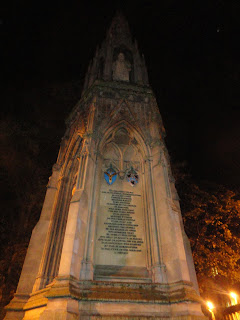
Martyrs' Memorial
The tour guide named Rob moved us throughout the oldest parts of Oxford, telling stories along the way. There were the students studying religion who died in collapsed tunnels where they hid when teachers came into the pubs where they had been drinking, and could be heard scratching the ground trying to unbury themselves. One man was sentenced to have his ear nailed to a post so he cursed the courtroom and nearly of its occupants died within a week of typhus, or jailhouse fever.

My favorite story occurred at Brasenose College of Oxford University. In the 1800s, a man known as a drunk was walking down a dark street next to the college when he saw a black robed figure trying to pull something out of a window. Now, this window was small, only about a foot wide by three feet tall, and it had metal bars over it. The man, who taught in the college, was frightened and ran passed, entering Brasenose. 

Inside, he learned that a student in his 20s has just collapsed on the stairs and died. This student was rumored to be president of the Hellfire Club, a club that got together to drink and cause mischief. However, legend has it that the members of the club worshiped the Devil and offered him their souls. 

The student was determined to have died from natural causes but it is said that on his face there were straight red marks, two vertical and one horizontal, matching the pattern of the window's bars. It is said that the drunken man had seen Satan in the dark street, trying to take the soul that the student had offered him.   

-------- 0 --------  

We were invited to a Halloween party thrown by some of the people from our American university. Partying is definitely not my sense but I thought I would make a short appearance and then leave. Libby dressed as a zebra with her knitted zebra hat and stripped shirt while Caitlin, Amy and I just wore our normal clothes. Caitlin just said she was a Muggle and, if needed, I could pretend I was a cowgirl since I was wearing boots and a flannel shirt.

Everyone seemed to be having a good time, considering the small space we were in. I was really impressed with people's costumes. There were several Captain Knickers (a version of Captain Underpants they thought the British would understand better), Oompa Loompas from Charlie and the Chocolate Factory and Harley Quinn. One British guy named Simon, dressed in an orange tiger onesie was friendly.

I was uncomfortable after about ten minutes so Caitlin and I slipped out of the door and across the small courtyard to our own flat. That was the extent of my celebrations on Halloween. Not very exciting, but perfectly acceptable for me, especially since I had to be up at 7am the next morning to get to class. 

Tuesday, 2 October 2012

Stonehenge and Salisbury Cathedral

Continuing on from Highclere Castle, our next destination was Stonehenge, one of the most famous landmarks in the world. On the bus while we ate a packed lunch of sandwiches, crips, an apple, and a KitKat.

Fun Fact: In the United Kingdom, KitKats are made by Nestle, not Hershey.

Dr. Forsaith told us some of the history behind the mysterious site. Stonehenge is believed to be between 4,000 and 5,000 years old. Scholars have only theories as to its purpose and the manner in which it was constructed. The stones used in its construction are native to another part of the country and would have probably been transported up the coast on rafts and then somehow moved several miles across land to the chosen site. Remember, each stone weighs somewhere between 25 and 50 tons.

Some people believe that the stone arrangement serves as a giant calendar to help predict the seasons, a very important function in an agrarian society. Others think that it is a religious site most closely associated with paganism and Druidism.

It was windy and grey clouds were gathering in the sky when we alighted from the coach. According to Dr. Forsaith, it is almost always windy at Stonehenge because the land around it is flat and there are no barriers to break the wind. After waiting in line for our tickets we went through an underground tunnel, emerging on the other side of the road. There were visitors from all over the world around us. I heard people speaking many languages including German, Japanese, and French.

A path was laid out in a rough circle around the stone with number markers spaced periodically, corresponding to information on our handouts that Dr. Forsaith gave us. The handouts were designed for grade school children but they still contained some interesting facts.

The henge itself was not all that engrossing to me, perhaps because I had seen pictures of it so many times in my life that I was unable to feel the excitement of seeing something new. I found the surrounding countryside much more enthralling with its green fields and burial mounds crowned with turbulent grey clouds.

Near the end of the circular pathway there was a person dressed in a dark cloak and robes, carrying a staff. No one in our group are sure it the person was a man or a woman. I did not look at him/her closely enough to know. I simply assumed he/she was a woman because of the long, pale orange hair, but someone else said they though it was a wig. There was a lively discussion on the coach ride to Salisbury about this mystery.

Apparently, there is a pagan group who feel that there must always be someone from their religion at Stonehenge. I am not sure why, maybe to protect it from sacrilegious visitors who might want to damage the stones in some way. Dr. Forsaith noted that he had never seen someone dressed in pagan robes at the site in the numerous times that he has visited.

We spent about an hour at Stonehenge and then boarded the coach for Salisbury, our destination being Salisbury Cathedral. Salisbury is a very pretty city with a small river running through the center. This river, surrounded on both sides by buildings, played host to a flock of ducks and swans.

Fun Fact: Under a 1482 law, the majority of the swans in the United Kingdom are owned by the Crown and it is a crime to kill one.

At the Cathedral we went on a tour to learn its history. Fundraising to get money to build the religious worship place began in 2017. Three years later, in 1220, construction began (I know these dates because the tour guide jokingly said there was going to be a quiz at the end and I decided to remember them just to be able to tell him the correct answer if asked). The church is immense with incredibly high vaulted ceilings which are awe-inspiring. The many windows are decorated with amazing stained glass, much of it the original ones from the 13th century. I can not imagine what it would be like for that to be my church I attended each Sunday.

Salisbury Cathedral is unique in that it was completed as one project instead of being added to over the centuries. The only addition to the building occurred in 2008 when a large baptismal fountain was added in commemoration of 750th anniversary of the Cathedral's completion.

Baptismal Fountain
Dr. Rowan Williams, the Archbishop of Canterbury blessed the fountain by marking the sign of the cross in oil on the fountain's four sides. The next morning when the cleaning woman arrived for her duties she saw the marks and thought that the church had been vandalized during the night. Using soap and water, she tried to scrub the marks away, but luckily the stone had properties that made it absorb the oil. The symbol of the cross remains on the fountain today.

Our tour lasted a little longer than expected so our group had to rush to see the Magna Carta before it was closed for the day. I was surprised to see that the words on the famous document were printed. I always just imagined that it was handwritten since it was created so long ago. Its text is impossible to decipher because the writers used a lot of abbreviations so as to fit it all onto one page.

When the tour ended we were given a short amount of free time to explore Salisbury before we had to be back at the Cathedral for Evensong. Libby, Caitlin, Amy and I just walked around looking for a Cashpoint (ATM in the USA), and then just resting at a picnic table. I enjoyed watching all of the school children walking by in their uniforms since school had just let out. It seems that light blue, navy, black and burgundy are the most popular colors used for school uniforms.

At about 5:20 we headed back into the main all of the Cathedral to listen to Evensong. There was not enough room in the fancy wooden seats in the center of the church so we sat in wooden chairs farther back. That was the section where the common people would have sat during medieval times.


All of the clergy and the choir singers processed to their places in a very ritualistic and traditional manner. They all wore red and white robes. Several of the choir singers were young girls probably between the ages of 7 and 11. They wore long white dresses with long sleeves, accompanied by a ruffled lace collar reminiscent of those popular during the Elizabethan Era, though on a much smaller scale.

The service consisted mostly of songs, some sung by the choir and some by all attendees. There was a short scripture reading and recitation of the Apostle's Creed. I was impressed how much of the Apostle's Creed I remembered from when I had to memorize it during Confirmation in the 8th grade. Everyone in the group found it foreign when the pastor began praying about the Queen and the government. These topics are rarely mentioned in churches in the United States because of the separation between church and state.

Sarum College
It was without a doubt a beautiful service, performed in a completely astounding venue. It held my attention better than most services at my church at home.

Next, it was time for dinner at Sarum College. We ate the delicious food in a small dining room with a buffet line and small tables. There was steak, fish pie, steamed vegetables, potatoes, and salad. I ate a bunch of vegetables because I was craving so nutrients. The desert was absolutely amazing. There were creme puffs with chocolate sauce and raspberry trifle. I had both and probably negated all benefits of the vegetables I had eaten for dinner.


Fun Fact: Cities in the United Kingdom must have a cathedral, otherwise they are considered to be towns or villages.

Friday, 28 September 2012

Highclere Castle and the Fashion of Downton Abbey

Within one week of arriving in the United Kingdom I found a new television show to add to my growing list of favorites. That show is BBC's Downton Abbey. Several people in the United States recommended the show to me and it is available on Netflix's instant streaming, but I just never got around to watching it.


I ended up watching it for the first time because one of the places we were visiting on our Heritage trips was the setting for Downton Abbey, Highclere Castle. Caitlin and Libby, both of whom were already fans of the show, insisted that Amy and I watch at least the first episode before our trip. So, that Sunday night, we moved our living room chairs into Amy's spacious bedroom to view the program. Let me tell you, Downton Abbey is an addicting show. From the first episode onwards you are enthralled by the characters and the complexities of their lives. Amy likes to describe it as a "classy soap opera" because it has all of the crazy drama of a modern soap opera, but it involves the lives of an upper class British family in the early years of the 20th century.


The television drama follows the lives of the Crawley family, the wealthy, titled owners of Downton Abbey, and all of their various servants. The family consists of Lord Robert, Earl of Grantham, his American wife Cora, and their three daughters, Mary, Edith and Sybil. It documents their lives through various catastrophes ranging from new heirs and illicit romances, to murder trials and the devastation of World War I. Many of the problems arise from the machinations of the very traditional Dowager Countess and the ambitious footman, Thomas.


The best part of Downtown Abbey for me is the fashion. Since the series covers nearly a decade in two series, you can see how the style of dress evolved and changed as time passed. During this time period, the dresses worn by women of wealth and status were beautiful and incredibly intricate. Their wardrobes often contained clothing in rich fabrics like silk, chiffon, brocade.


In the first series, set in the early 1910s, the silhouette is more fitted. The women wear corsets, the foundation piece of their undergarments, allow their gowns to fall properly on their hourglass figures. Several of the evening dresses, particularly those worn by Edith, feature the high empire waists found in the earlier Regency period. However, fashionable waistlines were inching lower towards the natural waist. Fancy dresses often featured short, gossamer sleeves which bared the arms and portions of the shoulders. To balance out the amount of exposed skin, all of the women wear silk gloves that reach to the elbow or higher.


Wealthy women of the time would employ a ladies maid to look after their clothing, help them to dress and undress, to do their hair. The hair is always worn pinned up in intricate braids and curls, and often accented with bejeweled hair ornaments.


Edith, Cora, Mary and Sybil Crawley
By watching Downton Abbey, we were able to get a sneak peek of the inside of Highclere Castle before we journeyed there on Monday, September 10, 2012 as the first stop on British Heritage and Culture tour of England.


Highclere Castle which is the country seat of the Earl of Carnarvon. The most famous inhabitant was George Herbert, Fifth Earl of Carnarvon, who discovered the tomb of Tutankhamen with Howard Carter in 1922. During World War I the castle was used as a hospital for wounded soldiers when they
returned from fighting the Germans in France.   


The coach departed at around 9:15 am, after we met our driver John, who was also our driver for all the other trips. I found him to be very nice with a humorous, playful personality. He liked teasing us about being cold, insisting that the weather was beautiful for Britain.


Highclere Castle is situated in a rural area about an hour south of Oxford. Driving on the roads closer to the castle was an interesting experience because it was only wide enough for one vehicle at a time. If someone came from the opposite direction, one vehicle has to pull off the road into the grass to make room for the other car. The speed limit also seems to be much higher on smaller roads here than they would be on a similar road at home. It is a little nerve-wracking riding in a coach that is driving on the going 50 miles per hour up and down steep hills, all while driving on the left side of the road.


When we finally arrived at Highclere Castle and passed through the front gates, this was the sight that greeted us.


Highclere Castle is an immense building laid out in a roughly square shape around the large central hall that is open the the second floor. The interior is full of ornate historic furniture in exquisitely decorated rooms. My personal favorite was the Lady's Drawing Room, probably because it was decorated in a very feminine style that I find appealing. It was also interesting to see the juxtaposition of modern family photographs next to painted portraits that are over a century old.


After slowly inching from room to room (It took forever because it was easiest to proceed in a queue), we went down the servants staircase, passed the Egyptian exhibit and finally made our way outside to visit the Ladies (restroom to my fellow Americans). I waited outside snapping pictures while Amy, Caitlin and Libby ventured into the incredibly crowded gift shop to buy postcards. When Amy joined me a little while later, our first English rain began sprinkling from the clouds. My raincoat kept me dry and surprisingly warm since it protected me from the rain. Poor Amy only had her light jacket, and not even an umbrella.


The rest of our stay at Highclere Castle involved huddling under a tree in an attempt to stay dry, followed by lots of picture-taking in front of the castle. At about 11:45 am our stay at Highclere came to an end as we piled back onto the coach to eat lunch. Next stop, Stonehenge!