Showing posts with label food. Show all posts

Friday, 7 December 2012

Out and About in Oxford-Town: Part II


Monday

For our last day without Amy and Libby, Caitlin and I tried to visit some Oxford University colleges that were open to visitors daily for free. Note the tried in that statement. Our plans did not go as well as we had hoped.

Our planned journey, based on opening times and the location of the colleges, was to go to:
1) St. Edmund's Hall
2) Harris Manchester College
3) Wadham College
4) Hertford College
5) Exeter College
6) Lincoln College

St. Edmund's Hall ended up being closed to visitors, according to the sign. We probably could have just walked in and pretended like we belonged their but I wasn't really brave enough to try. We walked down the winding Queen's Lane which is only wide enough for one car and surrounded by stone walls on either side. It is a very peaceful road as there are more direct roads to take and it probably isn't one most tourists notice.

The day was sunny with puffy white clouds. It was a bit warmer than on Sunday (about 44 degrees Fahrenheit), especially in the sun. The backdrop of blue sky allowed me to get some really great photographs during our walks from college to college.

Queen's Lane
Radcliffe Camera and University Church of St. Mary the Virgin
Both Harris Manchester College and Wadham College also had signs saying that they were closed to visitors. This was very frustrating since they were supposed to open at that time. At least Wadham College was closed for a "special event" so it actually had a good reason for not wanting visitors wandering around.

Since we were already at Wadham College on Parks Road, we decided to walk further down towards the Pitt Rivers Museum to see if Keble College was open. It was not on our original list of places to go but since we had plenty of time to spare before the other colleges opened at 2pm, we gave it a try. 

It ended up being a great decision. There was no sign out front saying that it was closed so Caitlin and I just walked in. We were trying to be incognito and look like we were supposed to be there, so when we walked by a group of students talking, I tried to start talking about exams. It was a nerve-wracking at first, but when no one demanded that we leave, I relaxed. We walked around the grassy inner courtyard to the side opposite the entrance and sat on a bench.

Keble College is absolutely beautiful. Architecturally, it is very different from the older colleges lining High Street. Built in 1870, the building is considered quite new by Oxford University standards. The neo-gothic structure features walls with designs formed from the arrangement of red and beige bricks. I think its architectural beauty is definitely in competition with Magdalen College for the top spot in my mind. 


By the time we left Keble College, it was only about 1:15pm and none of the other colleges we planned to visit opened until 2pm. So, we took the less populated streets than run roughly parallel to High Street to West Gate Shopping center for a snack. Caitlin and Amy have gone to Shakespeare's, a shop that sells only milkshakes, several times since it opened and told me how good it was. 

There are lots of flavors to choose from but I tried Bakewell Tart (Bakewell tarts are a pastry bowl filled with jam, sponge cake, almond icing and topped with a maraschino cherry). The milkshake was literally ice cream blended with an actual Bakewell Tart until it reached milkshake consistency. I found the texture a bit strange, a bit lumpy from the blended tart instead of smooth like a typical milkshake. It was still very good though, and I drank it way to fast.

Caitlin was going to try Yule Log, a special Christmas flavor, but they were out of the ingredients so she got chocolate brownie flavor...hot. Yes, Shakespeare's sells hot milkshakes. It sounds really strange, but according to the woman working there, it works really well depending on the flavor (aka, chocolate brownie flavor = good, skittles = really bad). She described the drink as similar to a really creamy, indulgent hot chocolate. Next time we go I think I might be adventurous and try a hot Mince Pie milkshake.

Our college visits after our milkshake break went no better than it did before. Both Hertford and Exeter were closed to visitors, and I completely forgot about looking for Lincoln College. Caitlin was really disappointed about Exeter being closed because that was were J.R.R. Tolkien studied. We have seen things relating to Doctor Who and Harry Potter now, so it is only right that we should do something to add Lord of the Rings to that list. We just satisfied ourselves by agreeing to go another day.

Before stopping off at the grocery store for dinner supplies, we chose to take a final walk, this time down St. Giles Street, past the Martyrs' Memorial (where we met for the ghost tour on Halloween). We were in search of a cemetery. That sounds really strange but we have been meaning to find one since we got to Oxford. Reading gravestones and trying to imagine the life of the person buried there is a lot of fun, though it could be considered morbid as well.

War Memorial
There is a small cemetery next to the Martyrs' Memorial at St. Mary Magdalen Church but there is a fence around it. We continued down St. Giles Street, going farther than we ever have before. Along the way we noticed an open door to what appeared to be an Oxford University college. It ended up being St. John's College. We went into the small, circular inner courtyard paved in grey stone, but there was not anything to see. There wasn't even a bench to sit on. 

This little journey allowed us to see the City War Memorial which is still encircled with wreaths of plastic poppies put there during Remembrance Day on November 11. Beyond the Memorial we found our graveyard.

The graveyard was attached to St. Giles' Church, nestled between to busy streets. We stayed on the pathway and tried to read the weather-worn stones. I felt it would be disrespectful to go walking in the grass over the graves. The stones I could read were more recent than I had expected. Most were for people who died in the 1800s. It could be that this particular graveyard was more recent, or it was older and we just could not read the words on the more aged markers.

   
We covered a lot of ground in one day, visiting parts of Oxford we had never been to before. As there is only about three weeks left in the semester, I feel like my time to see everything is running out. I want to imprint the sights of Oxford into my memory so I can look back on them when I am back in the United States.

Tuesday, 27 November 2012

Cadbury World and More Paintings

If you are an American and you hear the phrase, "The World of Chocolate," you probably think of Hershey Park in Pennsylvania. If you are British you probable think, "Cadbury World."

This attraction dedicated to chocolate is located in Bournville, outside of Birmingham. We took the long scenic route from the train station around a large brick building that turned out to be the factory. Despite being a relatively sunny day, there was barely anyone around. On the ten minute walk we probably saw about four people walking and passed a children's football (soccer) game.

I guess most of the people were just already inside the factory, as the lobby was full of families with young children. Some where buying sugary sweets from the gift shop while others waited for their tour time to be called. The lobby was decorated in shades of purple and grey. The employees wore button-down shirts with stripes of violet, lilac, and lavender which I thought looked very nice.


The first part of the tour took us through decorated rooms showing the history of chocolate and the Cadbury family. The first room was decorated like a jungle with trees, rocks, and even a small pool to resemble South America during the arrival of Cortez. Cacao was an important part of Aztec religion and daily life.

From there we moved throughout the centuries as chocolate was introduced to the Spanish monarchs and eventually became a delicacy of the aristocracy. In the early 1800s, John Cadbury began to sell drinking chocolate along with tea and coffee in his shop in Birmingham, England. His business grew and in 1861 his two sons, Richard and George, decided to establish a factory in a stretch of farmland outside of Birmingham. This land was named Bournville and the Cadbury brothers built a village around the factory to house their employees. There were cottages, bath houses, a church and recreation fields for both men and women.

Next up was a winding path through the actual factory. The factory was not in operation that day which  made looking at all of the equipment a little boring. Though, we did get another candy bar and a small cup of melted chocolate on the walk. The melted chocolate was smooth and very rich. It probably took me ten minutes to finish the little thing, but that is just because I like to savor sweets.

After buying a few treats in the gift shop we headed outside and around the factory building, past a massive playground with swings, twisty slides, and more, to the Essence of Cadbury. A small group crowded into a room and watched a humorous dramatization of how Cadbury Dairy Milk Chocolate was discovered. It definitely was not historically accurate. The real reason people went to it was to get more melted chocolate afterwards. This time you got about 1/8 of a cup of chocolate and one topping like marshmallows or shortbread crumbles. We sat outside in the sun, but none of us managed to eat that much chocolate even though we wanted to eat it all.

The factory was in a very large building, but it still didn't seem large enough to produce the amount of chocolate I feel like they must have too. I am not positive, but I think the factory in Bournville is the only one to produce Cadbury chocolates for Europe (Hershey's produces Cadbury branded chocolate in the United States).

-------- 0 --------

At this pointed it was only early afternoon so we took the train back into Birmingham for dinner. Since there was about 45 minutes until closing time, we hurried to the Birmingham Museum since it was not a far walk from the rail station. I knew nothing about what the museum was about. I just wrote down the directions in case we needed something extra to do.

It ended up being a great decision because the new exhibition was titled, "Love and Death: Victorian Paintings from Tate," which turned out to feature mostly Pre-Raphaelite artists. The main attraction was "The Lady of Shalott" by John William Waterhouse. The painting is probably one of England's most famous, and it is by my favorite artist.

"The Lady of Shalott" is a very large painting, five feet tall and six and a half feet wide. I never imagined that it was so large. It is strange to be standing in front of something real after seeing so many picture of it. Seeing famous paintings in person probably would have a greater effect of me than seeing a celebrity in person.

The Lady of Shalott by John William Waterhouse
The gallery also exhibited a John William Waterhouse painting that I had never seen before, titled, "St. Eulalia." It is not one of the paintings that normally come up when you search the internet for Waterhouse's paintings. It is different than most of his other ones in that it depicts a more religious scene as he normally deals with characters from the tales of King Arthurs and Mediterranean mythology.

The painting shows the body Eulalia, a young Christian girl who was tortured and killed by the Roman rulers for her faith. When she died, it is said that a white dove flew from her mouth, often seen as a symbol of her soul, and it began to snow, the whiteness covering her naked body.

St. Eulalia by John William Waterhouse
All of the paintings were beautiful and pleasing to my personal aesthetic. It was really difficult to try to absorb all of the details while still rushing to see everything before the museum closed. It turned out to be a great day full of sunny weather, sweet treats, and beautiful art.

Monday, 19 November 2012

Cultural History and Scones

On Friday the 9th, we decided to explore more of the attractions Oxford has to offer. The four of us met Beth and rode into downtown Oxford, walking down Cornmarket Street to the Ashmolean. The Ashmolean is a museum filled with ancient artifacts like pottery, weaponry, and coinage, as well as several art and sculpture galleries.

Most of the rooms focused on either British, Roman or Chinese history. I most enjoyed looking at the currency exhibition and the pieces of jewelry scattered throughout the various rooms. They had bills displayed from all over the world, including money printed by the Confederacy during the American Civil War. There were thousands of coins in a range of sizes marked with the ruler of the time. The biggest ones were about 1 1/2 inches in diameter with the smallest about 1/4 inches in diameter. If coins today were that small I think I would be loosing them all of the time. Historians use coins to determine who were the rulers of Ancient Rome as each emperor had their likeness stamped on coins during their reign.

We moved on to the art galleries which were decorated with jewel toned wallpaper to fit the time periods of the paintings in their gilt frames. I perused most of the paintings quickly, pausing to read the plaques describing the artist and painting when one caught my interest. I can appreciate art and fairly intelligently discuss the symbolism and possible meaning the artist was trying to convey, as well as art techniques used, but I am very picky about what art I really enjoy.

At one point we all got a little separated as the rooms all seem interconnected, creating the feeling of a maze where you don't know where each turn and new doorway will take you. I managed to find Caitlin and we sat on a bench waiting for the others. To pass the time we discussed the painting directly in front of the bench. The focus of the painting was a sitting figure with shoulder-length blond hair, robes of pale pink and cobalt, and a light shining around the head. My guess was that the person might be the Virgin Mary since I believe she is often pictured in pink and blue robes with a halo. Seated around the figure were older men with greying hair and thick beards. To the far right were two more people, a man and a woman, with golden halo hovering over their heads.

The halos suggested a biblical scene but I did not know which one. Caitlin and I tried to make up stories about what was going on, and why all of these men were surrounding this feminine figure. Giving up the guessing, I rose from the comfortably padded bench and read the information plaque. We were pretty far off the mark. The central figure, which we thought was a woman due to the longer hair, fair face, and pink robes, was actually Jesus as a child when he first preached to the learned men of his village.

By this time we had managed to find each other. Only one floor was left for us to see and we moved through even more art galleries fairly quickly. The final room was smaller than the previous ones and decorated with emerald green wallpaper. Looking in the first alcove, I found that all of the paintings were appealing to me, and I spent several minutes reading their information cards. It was only when I was moving to another section to the room that I saw it was dedicated to artists of the Pre-Raphaelite art form which happens to be by favorite style.

The Pre-Raphaelite style is highly detailed with an emphasis on Nature. The paintings often depict characters from literature and myth. Scenes deriving from the Arthurian legends, Greek mythology, and the Shakespearean plays were all popular with the artists of the style.

William Holman Hunt, John Everett Millais and Dante Rossetti are often considered the founders of the art movement, though I am most familiar with the works of John William Waterhouse.

The gallery featured several paintings by William Holman Hunt which I found breathtaking with their emphasis on detail and the use of vibrant colors. I particularly liked The Afterglow in Egypt. According to the information plaque, Hunt had a very hard time getting the Egyptian girl in the painting to stand still long enough to sketch her properly.

Afterglow in Egypt
by William Holman Hunt
In the opposite alcove, there was a Waterhouse painting, and I had a bit of an "Oh my goodness, this is an actual painting by John William Waterhouse" moment. The Internet is so useful to learn about art, but it can not compare to actually standing before a famous painting in real life.

Ariadne by John William Waterhouse
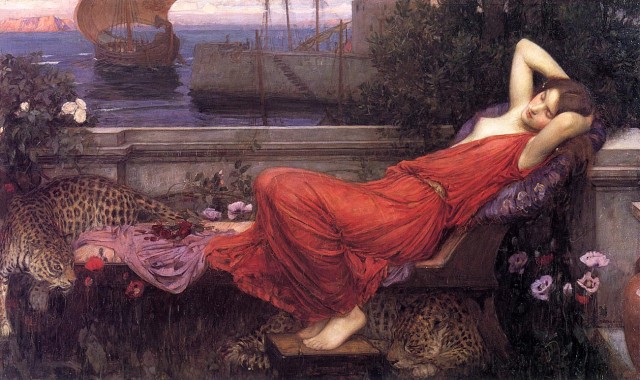
The Waterhouse painting in the Ashmolean was Ariadne. It depicts Ariadne, the princess who gave a ball of string to Theseus to guide hime in the Minator's labyrinth. The two fell in love and eloped together but the goddess Athena demanded that Theseus leave Ariadne on a beach. The painting depicts the young woman, two leopards at her feet, reclining as Theseus' ship sails away.

We left the museum after I finished looking at the Pre-Raphaelite room and made our way down High Street to the Vaults and Garden Cafe for afternoon tea. The Vaults and Garden is in a beautiful rectangular room with vaulted ceilings that is attached to the Church of St. Mary the Virgin. The rustic tables and chairs were made from dark wood, and the dim lighting gave the cafe a very cozy feel.

I ordered English Breakfast tea and a scone. The tea came in a small green teapot to keep it warm. There were steel creamers, only two inches high, for holding the milk and sugar cubes. The large, golden brown, freshly made scone was served with clotted cream and raspberry jam. The scone was crispy on the outside but soft on the inside. I cut small pieces from the bread, spreading it with clotted cream then jam. I ate very slowly to appreciate how delicious all of the food tasted. I absolutely love the idea of having tea and a small snack in the afternoon to hold you over until dinner.

Wednesday, 14 November 2012

Caves and Italian Food

This past weekend was full of activities with a trip to Cardiff on Friday, Bonfire Night on Saturday, and  then a trip to Chislehurst Caves and London on Sunday.

Amy, Caitlin and I have several days left on our BritRail pass so we looked for day trips that take less than two hours to get to by train. Caitlin suggested Chislehurst Caves, a place she had visited on a previous trip to England. Caves are cool, and a nice change from museums so we agreed. Libby was sick from Bonfire Night so she stayed at the flat to rest.

Chislehurst is a suburb south-east of London. The little bit of the town we saw on the walk to the caves seemed quite and traditional with its brick houses and corner pub. We worried that the caves would be difficult to fin but we had no problems at all. You just walk down the road from the train station, turn right past the pub and then there are giant brown signs pointing the way. It was probably only a seven minute walk from the rail station to the caves.

The tours started on the hour so we had about fifteen minutes to wait around in the lobby which was a combination of wooden pew-like benches and a separate room with a small cafe.

At noon, our tour group, made up of about six parents, six children, and us three, ventured down to the caves entrance which was under the building we were in. Old fashioned oil lanterns were distributed among the adults to light the way. Only a few parts of the caves were fitted with electricity and lights from flashlights, cameras, and other technology would not be good for our eyes inside the caves (therefore I have not photographs from inside the caverns).

The Chislehurst Caves were formed completely by hand as the Druids, Saxons, and Romans mined for chalk. The maze of caverns would measure 22 miles if it could be stretched into a straight line. Over the centuries it has played host to sacrificial ceremonies of the Druids, music concerts, and murders hiding bodies.

During WWII, when London was being bombed by the Germans, 15,000 people used the caves as a bomb shelter. Families would pay a weekly fee and be assigned an "address" which would be painted on the cave wall. There were showers, a hospital and a chapel. People slept on narrow bunk beds, at least three beds high. Every night at 10:30 pm, all lights had to be extinguished because they could be seen through cracks in the ground by the German planes flying above. This would leave thousands of people in absolute darkness until morning. I have no idea what you would do if you needed the toilet in the middle of the night, but the rules worked. Not a single person died from bombings while sheltered inside the caves.

One child was born in the caves in the hospital. The baby girl was christened in the cave's chapel and named Cavena, though she preferred to go by Rose.

In the mid-20th century, musicians discovered the pleasing affects of the cave's echoes and began to hold concerts down in the caverns. David Bowie, Pink Floyd, the Rolling Stones and Jimi Hendrix all played there at one time or another.

Our group looked at the chapel before moving farther into the dark reaches of the cave with only out lanterns as light. We stopped at the alter of the Druids where women and children were sacrificed to the gods. Our group was told by the tour guide to gather in an alcove next to the alter and he would leave us in the dark for several seconds to experience the all consuming blackness. Caitlin was kind enough to hold my hand for this part. I was not frightened, but it is nice to know that you are not alone when you can not see anything.

The guide walked some ways away and began to bang on a metal drummer to show us how well sounds travel in the confined space. The drumming stopped and we waited for him to come back when, "Bang!," he hit the drum one more time incredibly hard. We all startled and jerked then began some nervous chuckles to ease the tension. I was trying to listen for the tour guide's footsteps coming towards us. Everyone screamed as his flashlight came on right before us. I guess he had used the time we were recovering from the loud bang to make his way back to us unheard for the express purpose of scaring us.

Next we moved on to the area that was considered most haunted. Before walking down the narrow corridor to this area, the tour guide said, "Now, before people report seeing a white mist, they usually feel a chill and sometimes the echoes in the cave are dampened. It is impossible to feel a chill because the caves are always at a constant temperature of 50 degrees Fahrenheit not matter the weather outside."

Right when he said that I felt a chill move down the back of my body until a tingle set up residence in the backs of my calves. Then when we walked through the tunnel to the cavern beyond I thought that the echoes were less pronounced. The tour guide remarked on that too. I decided to focus on looking straight at the tour guide instead of looking around for fear of actually seeing something possibly supernatural in origin.

He told us that the ghost is believed to be that of an 18 year-old woman who was murdered by her husband, a miner in the caves, in the late 1800s. He weighed down her body and dumped it into the pool in the cavern where we stood. Her skeletal remains were not discovered until the 1930s when workers were preparing the pool to be used for irrigation to grow mushrooms in the caves.

The tour ended soon after and we caught the train back into London. We walked around Covent Gardens and admired the Christmas decorations that were already put on. Suspended from the roof over the market were giant red ornaments and shiny disco balls. The varied slightly in size but most had to have been at least six feet in diameter.

We spent a long time wandering around looking for a candy shop that Caitlin had visited on her last trip to England. We were about to give up the search when we found the little shop with its red awning. Amy bought toffee bits to try to replicate the toffee and whipped cream combination we had on our Starbucks samples in Cardiff. Caitlin bought some pear drops and cherry bakewells.

Pear drops look just like gumdrops, but hard. Amy found out that out the hard way when she tried to bite into one. I really did not like those because they tasted too artificial. The cherry bakewells on the other hand were delicious. The hard candies are based on an English tart of the same name made from cream and cherries. They were amazing because they did not have the fake cherry flavoring. The candies tasted just like black cherry ice cream to me. If we ever find ourselves in that part of London again I will be buying some to take home with me.

Our lunch was eaten at Bella Italia, an Italian restaurant where Amy ate with her parents when they were visiting. I had Cannelloni Ricotta which was a rectangular noodle spread with ricotta cheese and spinach and rolled up. The tomato sauce was creamy, orange was delicious. It actually tasted quite similar to the tomato soup served in one of the eating places at my American university.

Before dark we walked down to Piccadilly Circus, just to say we have been there. Some post cards were bought and we popped into the M&M store to look around. As the sun went down we headed back to Oxford, not wanting to be wandering around London in the dark.

Saturday, 27 October 2012

Natural History and Brownies

Today I woke up and things were quite different from usual, not bad, just different. I got up at 9 am, took a shower, ate breakfast and just puttered around. At 11 am I went to see if my flatmates were awake. Caitlin opened her door and said that she was just getting up. It was only then that I remembered that Amy had gone to London yesterday to meet up with her parents and Libby had left early this morning to go to Scotland with her parents. So, it is just Caitlin and me in the flat this weekend. It is strange because the four of us have been almost constant companions for the past (almost) two months.

Earlier in the week Caitlin and I had already planned to do some exploring in Oxford over the weekend since it would just be the two of us. Our choices were the Botanic Gardens and/or the Pitt Rivers Museum. We did not decide where we were going until this morning when we checked the weather and it was only supposed to be a high of 48 degrees Fahrenheit. That is almost a 10 degree drop from yesterday and it is supposed to continue to be that cold for at least the next week. The weather here is finally turning frigid, and I am very glad I bought a coat at Primark on Wednesday (it is wine colored with scalloped detail and I absolutley love it).

The Pitt Rivers Museum is in a part of Oxford north of High Street where we had not yet explored. We walked along a two lane road that had a lot of cars, since I guess that area is not considered the City Centre (only buses, bikes and taxis are allowed in the City Centre during the day). The sidewalk was incredibly crowded, mostly with university students who were probably head to or from class as most of the buildings lining the road appeared to be more colleges of Oxford University.

After a bit of confusion about the signs to Pitt Rivers (one sign pointed left but I was positive it was supposed to be on the right. The first sign ended up being for parking for the museum), we made it to the museum. You walk in through a heavy wooden door and the first things you see are giant dinosaur skeletons. I was surrounded by bones and fossils and rocks. If I could have visited this museum at around age 7-11 I would have been in absolute heaven. During that time I changed back and forth from wanted to be an Egyptologist, archeologist, paleontologist and geologist. I collected fossils and rocks and they were my prized possessions.

Even at my current age I was positively giddy. A lot of the displays were designed to be touched. There were stuffed animals like a fox, pheasant, badger, and cheetah that visitors can pet. One adorable little girl with blond curls ran up to the stuffed Shetland pony saying in her British accent, "Look, Mummy, a Shetland pony. It's a Shetland pony." Little children with British accents just make me "Awww" in my head because they are so cute.

Caitlin and I slowly made our way around the room looking at all of the displays about rocks, dinosaurs, modern animals, and insects. I also took some time to appreciate the architecture. The glass ceiling stretched overhead, two stories up. It is all held up by carved granite columns and a diamond shaped weaving of metal supports.


The Pitt Rivers Museum is actually where Lewis Carroll, who lived in Oxford and lectured at Christ Church, got a lot of ideas for Alice in Wonderland. The museum has an entire display case with all of the animals featured in the stories, birds, lizards, and even a white rabbit. The Dodo bird has its own case with a skeleton of a Dodo and a model of what it would have looked like. I learned that Dodo birds are not naturally the large, round and clumsy animals that they are normally thought of as. In reality, the Dodos that were kept in captivity were given the wrong food so they grew obese.

In a separate room there is the collection of cultural artifacts. The room is three stories tall and filled to the brim with all manner of things from cultures around the world. There is pottery, clothing, model ships, musical instruments, models of traditional homes, woven baskets, oil lamps and much more. Caitlin and I played a little game of trying to guess what country, or at least what continent, the various pieces came from. There is so much to see that it would take days, if not weeks, to see it all.

It was amazing to see how similar items were that were from cultures on the other side of the world from each other. Many cultures use horns to communicate and create music. Many ended up with the same style of oil lamp, probably because the shape was the most efficient. It was like this one room showed how interconnected all people of the world are. All human beings are the same regardless of skin color or ethnicity.  In that room I felt, not like an American or a caucasian female, but simply a member off the human race, connect to everyone else in some way, past and present.

Before even finishing the ground floor, Caitlin and I both started to get hungry so we decided to visit the museum again another day (entry is free). We ended up at the Covered Market on High Street and chose to eat baguettes at Morton. The goat cheese on Caitlin's baguette reminded me of our four hour long study abroad orientation in May. That orientation was so long ago now, and the most memorable part was the snacks. Those snacks included goat cheese, crackers, fruit and brownies. One thought led to another, and suddenly I was craving brownies.

I knew that we had all of the ingredients to make brownies except for cocoa powder so I thought this would be a good opportunity for Caitlin to show me the Tesco she had found a ways down Cornmarket Street when she explored Oxford by herself the other day. The Cornmarket Tesco is not as spread out as the one on Cowley Road, instead it has two floors. We had to look in several places before we found the cocoa powder in the section with the coffee, tea and hot cocoa. With our last ingredient in hand, we headed back to the dorm.

The walk back was uneventful. The narrow trail from Pullen's Lane to our dorm, passes by the nursery, an area of land where people can plant gardens and vegetables. Today, someone was burning wood or leaves in a bonfire and the air held its earthy, burning smell. I knew that if I stopped and closed my eyes I would be able to perfectly picture myself standing outside my home in North Carolina, surrounded by tree draped in fiery hues. The brisk wind of Autumn and the smell of wood fires are two things that go perfectly together in my memories.

Back at the dorm we started baking our brownies. It was not difficult at all, just mixing a few ingredients together then pouring it into a pan. I waited the required time, 25-30 minutes, but the bottom was still gooey while the top seemed cooked. This seems to happen every time I have tried to bake here. The oven, which is super tiny, doesn't seem to cook the bottoms of things properly. We ended up cooking the brownies for an extra 15 minutes and I think they ended up a bit over cooked. However, they were still delicious and satisfied my brownie craving. We probably will get used to how the oven just in time for us to leave, but that is just the way things go sometimes.


Monday, 22 October 2012

One Pub, Two Pubs, Three Pubs, Fight

This week my friend Amy's parents and two of their friends came to visit. Mrs. Stamm, Mr. Stamm, John and Maureen invited us to eat dinner with them on Friday night. The evening started out on a bit of a sour note when the 6:35 bus did not show up (we were at the stop five minutes early). We ended up walking, it was less than a mile, but it wasn't entirely pleasant since it was drizzling. The rain had made the fallen leaves on the sidewalk slick and mushy underfoot. We had to step carefully to be sure we did not fall.

The Britannia 
Our fifteen minute walk go us to our meeting spot, a pub and restaurant called the Britannia. The pub had a very warm, cozy feeling with brown decor and well padded chairs arranged around round tables. After making our introductions, we perused the menu. I decided to try the Beef and Ale Pie, since I have had Chicken and Mushroom Pie since I have been here and really enjoyed it.

We all went up to the bar to order and it was incredibly crowded with other patrons trying to put in their drink orders. We waited in front of the cash register for nearly ten minutes before we found an available employee to order from. The next problem of the night occurred when the woman taking our orders informed us that someone had hit the emergency fuel stop button on the fryer so any food would take at least an hour to be prepared. After much discussion, it was decided that we would find another place to eat at. An employee at the Britannia recommended the Black Boy, another pub that was of of the main road.

Turning off of London Road onto Old High Street, we began to walk along a residential road with few street lamps. It was very dark and the rainy drizzle was still coming down. I was expecting the Black Boy to be just a little ways off the main road, but as we kept walking I wondered just how far away it was. We walked ten minutes before the pub came into view (about 0.5 miles).

Inside the Black Boy looked very fancy with black leather chairs arranged around tables with white tablecloths and crystal wine glasses. Mr. Stamm approached the hostess who told him that they were fully booked, though at the time we could only see about four people eating in the establishment. Perhaps there was supposed to be a large party there later in the night. Keep in mind, it was about 8:00 pm by now. It seem like people here in Britain eat very late when they go out, often sometime after 8:00 pm or even 9:00 pm.

The evening was turning into a real pub crawl as we headed back to London Road. My roommates and I rarely eat out so we had no where to recommend except Posh Fish but we eliminated it from the choices because it has only about four tables, not enough for the eight of us. We ended up at the Royal Standard Pub, only two doors down from the Britannia where our pub crawl began.

The Royal Standard
The Royal Standard looked like a typical English pub with its thick wooden tables, bar, and white washed walls. Hanging on the wall to my right there was a flat screen television playing some kind of an Indian soap opera with the dialogue printed on the bottom of the screen. It was hilarious to watch the bad, over the top acting and the cheesy dialogue. The soap opera was followed by a comedy show where two women were trying to prove that they were not middle-aged by staying up all night in competition with their younger friend. They both ended up completely exhausted even after taking shots of coffee and Red Bull and finally resorted to eating coffee grounds. These both just seemed like such strange television programs to watch in a pub where you would expect to watch rugby or football (soccer).  

This third pub had almost the same food offerings as the Britannia, so I did end up ordering the Beef and Ale Pie. Libby, Amy and I shared a pitcher Fruit Salad, a drink containing orange juice, Smirnoff Ice, some kind of melon flavoring and lemonade (lemon-line soda). It was a pale green and slightly thick (probably from the orange juice), not at all what we were expecting. I only drank about half a glass because it had alcohol in it and I do not really feel comfortable drinking yet, even though I am of legal age in Europe.

It was nearly 9:00 pm when we got our food (we probably should have just stayed at the Britannia and we probably would have eaten by then). My dish came with the Beef and Ale Pie, brown gravy, peas, and a mound of mashed potatoes. The amount of mashed potatoes was probably the equivalent of at least one entire baked potato, probably more. The pie had very hard crust that was hard to cut, even with the knife, and contained only chucks of beef and gravy. I really did not care for the pie because it tasted to much like beer. I think I will stick to chicken and mushroom from now on, but at least I can say I have tried a traditional English dish.


Everything was going smoothly. We had finished our meals and were putting on our coats to leave when two men standing at the bar, about fifteen feet from us began shouting. They had been arguing loudly earlier then went outside, only to return to the pub a little while later. I had ignored them because I was listening to Mr. Stamm tell a story. Just as I stood up to put on my blazer, the two men whom I will call Green Shirt Man (GM) and Orange Shirt Man (OM) began to fight.

GM pushed OM to ground, hand around his throat. OM tried to kick GM, but GM grabbed onto his shirt and completely ripped off OM's shirt, in a manner quite reminiscent of the Hulk. Now, Orange Shirt Man was technically No Shirt Man. They began rolling around on the floor, hitting each other until they were at our table, though at the other end from where I was standing.

At this point I looked up, expecting to see one of the bar employees stepping in, or at least calling the police. The young man attending to the bar was just standing there smirking, like he was enjoying the free entertainment. He just stood there until another employee, a young blond woman, hit him in the arm and seemed to be telling him to get someone from the kitchen. I was absolutely amazed that he would just stand there and not do anything. I would think that anyone working in a bar would have some training as to what he or she should do if a fight broke out.

Out of the corner of my eye I saw Amy walking to the door, and I automatically followed her, thinking that the safest course of action would be to leave. I missed the rest of the fight but Libby and Caitlin, who left after Amy and I, told us what happened.

Libby and Caitlin were moving to leave when GM, after banging OM's head into the floor, picked up a chair to hit OM with. That is when John, Mr. and Mrs. Stamm's friend, stepped in and told him to put down the chair. Mr. Stamm ushered Libby and Caitlin outside as a woman in the pub, presumably someone who knew the men, began yelling, "That is enough. Stop, that is enough." I could see through the window that Maureen, John's wife, was beckoning him to come with her and leave.

Once everyone was outside, all we could talk about was the fight. Caitlin, who was closer to the men than I was, said she saw blood all over OM's face after GM bashed his head into the floor. I am glad I left when I did because I really did not need to see that. Less than two minutes later an ambulance sped by in the direction of the pub, and we watched to see if that was where is would stop but I think it kept going. If it was going to the pub then their response time is amazing. Later, when we were nearly back to our dorm a police car raced passed us, blue lights flashing, and we guessed that was the response for the pub fight.

This was one of the few fights I have every seen in my life, the only one that involved grown men. During high school, there were several fights a year but I only witnessed two in my entire four years there. More than once I walked right by a fight and did not notice it because I was so focused on getting to class on time.

The evening was certainly eventful, though I am afraid it gave Amy's parents the impression that Oxford is a dangerous city when it is actually quite safe.